In conversation with Martin F. Schmidt, the architect of practical transformation
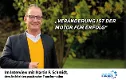
A man who not only shapes change but lives it: Dipl.-Ing. Martin F. Schmidt, founder, managing director, consultant, coach, and multiple award-winning implementer, exclusively shares insights from over 30 years of transformation practice in an interview with Silicon Valley Europe. He has guided more than 400 companies on their path to a secure, efficient, and future-proof future – not with PowerPoint slides, but with real change, tangible results, and an impressive hands-on mentality.
From machinist at Melitta to international transformation architect – Martin F. Schmidt combines engineering spirit, entrepreneurship, and a deep understanding of people and organizations. He discusses the challenges facing SMEs, Lean Management, process optimization, restructuring, and how his 360° Empowerment Method enables companies to fully unleash their potential sustainably.
Particularly exciting: Schmidt openly shares his philosophy of “Experience, understand, act,” about leadership without ego, responsibility without blame, and why securing the future always starts with people – not technology. His vision: to strengthen companies so they not only survive but grow with innovation, clarity, and humanity.
In the interview with Silicon Valley Europe, Mr. Martin Schmidt answers our questions with incredible energy, empathy, and entrepreneurial sharpness. That’s why we also explore in the conversation: How can real change succeed without resistance? Why is success not a goal but a process, and what does it really take for traditional SMEs to thrive in times of digitalization, globalization, and skilled labor shortages?
We believe this interview is a must-read for anyone in a position of responsibility – for structures, people, and the future. Get ready for inspiring answers, clear words, and insights into a world where implementation counts and humanity is the decisive success factor.
Silicon Valley Europe: Mr. Schmidt, your career path from machinist to international leadership positions and multiple award-winning business consultant is extraordinary. Which experiences have personally shaped you the most?
Martin F. Schmidt: My career has taught me one thing above all: to take responsibility – not just for what I do, but also for what I fail to do. This includes openness and honesty, even when the truth is uncomfortable.
Early experiences, such as changing schools multiple times, showed me that results often don’t depend on others but on complacency or misplaced priorities. Even projects that didn’t go as planned led to the same realization: What did I overlook? What did I neglect?
Particularly formative were situations we overcame as a team. I learned that only a team can solve major challenges, but someone must take responsibility for coordinating the team and clearly defining the goals.
In summary, I can put it in one sentence: Have I or have we done everything in our power to achieve the goal? This question has stayed with me and shapes my actions both personally and professionally.
Silicon Valley Europe: You say: “Change means change – and success is the engine of success.” What was the defining moment in your life when you developed this understanding?
Martin F. Schmidt: The statement “Change means change – and success is the engine of success” was something I developed primarily through practical experience. People often ask, “What do you want to achieve in five years?” That’s important, but at least equally crucial is the question: What do we want to achieve in the coming month, next quarter, or by the end of the year?
Successes must be visible and tangible in the short term – so-called quick wins – so that employees gain motivation and trust in the change process. Visible successes enhance the credibility of the measures and simultaneously create room for further initiatives.
For me, it becomes increasingly clear just how powerful this effect is: even small, quickly implemented successes mobilize the team, unleash momentum, and pave the way for larger changes. The message is clear: success breeds motivation – and motivation drives further success.
Silicon Valley Europe: You have been supporting companies in transformation, restructuring, and future-proofing for over 30 years. What sets successful change processes apart from those that fail?
Martin F. Schmidt: Successful change processes are characterized above all by their respect for the organization’s reality: those who believe they can implement everything internally often underestimate the complexity and resources required to achieve sustainable results. Success arises when leadership recognizes where internal strengths lie and where external expertise can usefully be deployed as a ‘force multiplier.’
The key point is that change cannot be forced. Companies that fail are often those that either underestimate complexity or try to handle everything alone – and then run out of resources, patience, or experience. Successful transformations, however, combine self-responsibility and initiative with targeted external support: leadership makes clear decisions, leverages external experience where it delivers tangible added value, and in doing so creates speed, quality, and sustainability.
Failure occurs when internal forces are overwhelmed or critical expertise is missing. Success comes when you make smart decisions about when internal resources suffice and when external support makes the difference – and do so openly, collaboratively, and with clear goals.
Silicon Valley Europe: With your 360° Empowerment Method, you combine potential analysis, implementation, and sustainable anchoring in companies. How did this method emerge – and why does it work so effectively?
Martin F. Schmidt: The 360° Empowerment Method emerged from our many years of experience. We have seen that change projects often fail because they focus only on individual areas while losing sight of the entire company with all its departments and strengths.
Our method takes a holistic view of the company: all areas are included in a 360-degree approach, from executives and teams to processes, structures, and culture.
It combines three elements: future analysis (potential analysis/current assessment) to identify strengths, development opportunities, and bottlenecks; shaping the future (implementation) to make concrete measures measurable and effective; and sustainable anchoring to ensure changes take lasting effect – that is future resilience.
The impact arises precisely from this: the holistic view reveals connections, measures reinforce each other, and the organization experiences change as plannable, comprehensible, and sustainable. This is how we create speed, clarity, and genuine effectiveness – while simultaneously strengthening trust and personal responsibility among all those involved.
Silicon Valley Europe: Lean Management, Kanban, JIT, digitalization – you haven’t just advised on all these topics, but have practically implemented them. What do you see as the most important success factor for methods to truly work in practice?
Martin F. Schmidt: The most important success factor for methods like Lean Management, Kanban, JIT, or digitalization to truly work lies in two key points: First, the right mix of methods. There are no standard solutions or one-size-fits-all approaches. Every organization is unique – processes, structures, culture, and strategic goals must be considered. Methods must be individually selected, adapted, and aligned to ensure they are effective.
Second, the human factor. Methods alone do not drive change. What matters is that employees and managers understand the goals, recognize the benefits, and are actively involved. Motivation, trust, and personal responsibility are the driving forces that make implementation successful.
In short: Methods are merely tools. Success comes when the right tools are intelligently combined and the people in the company embrace, understand, and live them.
Silicon Valley Europe: You have accompanied over 400 companies – from SMEs to large corporations, from crisis to growth. Is there a project that has particularly moved you emotionally or professionally?
Martin F. Schmidt: Looking back on the many projects, there is one that has particularly moved me both professionally and emotionally: We recently advised a large, international family-owned company based in South America at its German site. The products in mechanical and plant engineering are highly complex and strongly networked across many global locations – an enormous challenge.
What was particularly impressive was that, after just a few weeks, the first results were achieved significantly earlier than planned and could be presented to the managing shareholder by the workforce themselves with great enthusiasm. What made this project emotionally moving in addition was the active participation of all involved – management, works council, and our consultants – and the fact that no distinctions were made between “top and bottom” or “here and there.” ProGemma was seen as an integral part of the company.
Projects like this are particularly moving for me because they show that, after years of stagnation, a site can come back to life – and that real change is possible when everyone pulls together and people are at the center.
Silicon Valley Europe: When you enter companies, many say about you: “No PowerPoint consulting, but real implementation.” What does “implementation power” mean to you personally?
Martin F. Schmidt: To me, ‘implementation power’ primarily means taking responsibility and delivering results instead of getting lost in analyses or presentations. It’s not enough to develop concepts – real value is created only when ideas are implemented concretely and produce tangible results.
A key factor here is goal acceptance: implementation succeeds only when all involved understand, support, and actively commit to the goals. Implementation power also means thinking practically, identifying obstacles, and finding solutions that work in the real corporate day-to-day business.
In short: implementation power is the ability to turn vision into tangible reality, proactively overcome obstacles, and achieve sustainable results – driven by clear, accepted goals and the commitment of all stakeholders.
Silicon Valley Europe: You repeatedly emphasize: “Success happens where people want to – not just can.” How can employees be won over to change and resistance be transformed into motivation?
Martin F. Schmidt: I am often asked how to win employees over to change. Put differently: change succeeds where employees are not demotivated.
When obstacles, barriers, or disruptions are removed – including in the interests of the workforce – momentum quickly builds. People take initiative, resistance turns into motivation, and change processes gain momentum.
In short: success happens where people want to – not just can – and our task is to create the conditions under which this desire can flourish.
Silicon Valley Europe: In times of digitalization, skilled labor shortages, and global uncertainty – how can medium-sized family businesses secure their future viability today?
Martin F. Schmidt: Today, medium-sized family businesses secure their future viability through a combination of strategic foresight, flexibility, employee focus, and the targeted use of new technologies such as AI.
This means we need strategic foresight to recognize our own strengths and unique selling points and translate them into future-proof business models. AI can help us better utilize data, optimize processes, and make more informed decisions.
Moreover, flexibility and adaptability are crucial. Companies must respond quickly to market changes, digitalize processes, and simultaneously ensure the quality and reliability of their products.
Last but not least, “employees are the key to success.” Attracting, retaining, and actively involving skilled professionals is essential. AI can take over routine tasks, freeing up time for people to focus on value-adding work, thereby fostering motivation and skill development.
Silicon Valley Europe: You were awarded the title “Top Consultant 2024,” with a laudatory speech by Christian Wulff. What does this success mean to you—and is recognition still a driving force?
Martin F. Schmidt: Awards like “Top Consultant” are always snapshots—they reflect performance at a specific point in time but do not replace the continuous development of people and organizations. Many years ago, I received the title “Certified Management Consultant,” and even then, the message was clear: such honors confirm that work has an impact, but they say little about how organizations and people are evolving today and in the future.
This year’s award was particularly moving because Christian Wulff subsequently invited me to participate in the Think Tank. These days are always filled with intense discussions, honest exchanges, and inspiring encounters with leading minds in the consulting industry. We address key future topics—from the role of consulting in times of change to responsible, sustainable action—and engage in genuine dialogues on equal footing. This applies not only to business but also to politics.
For me, recognition is therefore not just praise but also impetus and motivation to continue working in a practical, partnership-oriented, and future-focused way.
Silicon Valley Europe: Your work is characterized by clarity, honesty, and speed. Have there been situations where this attitude caused irritation—or precisely because of it led to success?
Martin F. Schmidt: My work is shaped by clarity, honesty, and speed – and it is precisely this attitude that leads to success. Sometimes, it causes irritation: people feel slighted or are surprised because they rarely act so directly themselves.
This direct approach, however, is appreciated because it is not about wanting to please, but about achieving results. Even during acquisition, I speak plainly: the goal is to jointly achieve tangible results. The combination of directness and focus on impact ensures that projects quickly gain momentum and are implemented successfully.
Unfortunately, this openness also has its downsides. In acquisition, I often read the words “overwhelmed” or hear “We’ll take the first step” or “We don’t know if our employees will go along with it.”
Silicon Valley Europe: At the turn of the year 2024/2025, you integrated your ProGemma GmbH into the BLECKWEHL GROUP and handed over responsibility. What does this new phase mean for you personally and for your mission “We secure the future”?
Martin F. Schmidt: My goal was to shape the succession early on and thus take responsibility for the company’s sustainability. With the integration of ProGemma GmbH into the BLECKWEHL GROUP, I moved into a new role in January 2025: since then, I have no longer been a shareholder of ProGemma and therefore no longer bear entrepreneurial responsibility.
What remains is the responsibility for implementing our demanding customer projects – as overall project manager or, if desired, on the advisory board.
Silicon Valley Europe: You have been volunteering for many years – among other things with ICH e.V. (International Children’s Help). What role does meaningfulness play in your life and work?
Martin F. Schmidt: Meaningfulness plays a central role for me – both privately and professionally. It is not limited to my commitment at ICH e.V., but runs through many areas of my life. Wherever there are special challenges to overcome – be it in the municipal, social, educational or ecological environment – I have supported projects on a voluntary basis and accompanied them until implementation. What is particularly important to me is helping disadvantaged people and giving something back to society.
This principle also applies to the ProGemma GmbH that I founded: work has the greatest impact when it sustainably advances people, organizations or society. For me, meaningfulness is therefore always a driver of motivation, commitment and successful implementation.
Silicon Valley Europe: If you could give young entrepreneurs one piece of advice – what would it be?
Martin F. Schmidt: If I could give young entrepreneurs one piece of advice, it would be this: Start small and understand the essentials. Don’t overstretch yourself, but focus on the core of your business, think consistently from the customer’s perspective and maintain humility towards the market and customers.
It is also important to do what you are passionate about: passion is the strongest driver and often leads to success the fastest. Those who approach their company with enthusiasm recognize opportunities, motivate others and implement things effectively.
Silicon Valley Europe: We’ll simply say thank you for this wonderful conversation!