In the interview with Christan Menk, CEO of Fujitsu Enabling Software Technology
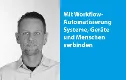
Fujitsu RunMyProcess helps leading companies in nearly 50 countries to master the technological challenges of digital transformation. Based on an innovative cloud platform, the RunMyProcess system enables its customers to quickly and easily automate their workflows, as well as create and execute business applications and business portals.
In an interview with Christian Menk, Managing Director of Fujitsu EST (development partner and sales DACH for Fujitsu RunMyProcess), we discuss flexibility and the major challenge of implementing digital transformation within companies.
DIGITAL FUTUREmag: Mr. Menk, the entire IT world has changed dramatically in recent years. Many speak of disruptive change here, where all topics in the company are put to the test. The central topic is, of course, digital transformation. Whether it's process optimization, IT security, or the topic of the new world of work, there is still a lot of catching up to do in the SME sector. In your opinion, what is currently the biggest challenge for decision-makers?
Christian Menk: In my opinion, it is particularly important for SMEs to address the challenges of digitalization in a flexible, cost-optimized, and yet future-proof manner. Finding the right solutions for the digital future often requires experimentation in pilot projects that are only scaled up if successful ("fail early"). This must not, of course, incur excessive costs. However, if the experiment is successful, the solution must be rolled out quickly, often in multiple regions, without having to redesign it compared to the pilot.
DIGITAL FUTUREmag: You mention connecting systems, devices, and people. Why do you think this is so important, and does this have anything to do with workflow automation?
Christian Menk: Connecting devices and systems with each other has always been a central challenge for IT. Although including people (users) has always been important, the advancing digitalization of all business processes means that everyone is now dealing with these digitalized systems. "User engagement" therefore takes on a whole new meaning: workflow automation and the digitalization of all business processes can only succeed if all users in the company feel like masters of these systems, not slaves. The new platforms must therefore put people at the center.
DIGITAL FUTUREmag: Processes in companies often change faster than one would like. What flexibility does your RunMyProcess system offer in this regard?
Christian Menk: RunMyProcess is the ideal low-code platform for digitalising non-trivial processes while giving business managers the freedom to make quick, flexible changes. The decisive factor here is the cloud-native implementation, which enables practically unlimited scalability at low entry costs. The user interfaces generated by RunMyProcess are automatically available on any (mobile) device without additional effort thanks to adaptive design, so that even with frequent adjustments, roll-outs for a wide range of user groups remain manageable.
DIGITAL FUTUREmag: Many applications are now being used on mobile devices. To what extent can mobile business applications be integrated? Could you perhaps give us a few examples?
Christian Menk: RunMyProcess applications are designed to be mobile by default, but of course any other business application (via its web API) can also be integrated. This means that Office365, Salesforce, SAP can be easily integrated, as well as any type of legacy application with a web interface.
DIGITAL FUTUREmag: On your website, I read an interesting case study about Fraikin, a leading commercial vehicle leasing company. Why did the company choose the RunMyProcess solution and what effects were achieved?
Christian Menk: Fraikin wanted to simplify, accelerate and make error-free the creation of complex, customer-specific leasing contracts (i.e. their core competence). Despite strong growth in business volume and number of employees, no flexibility was to be lost. To achieve this, Fraikin used RunMyProcess to digitalise all paper-based processes based on cloud technology. The seamless mobile communication with the customer, based on the RunMyProcess platform, also ensures sustainable proximity to the market and customers in the future. For us, this is the epitome of a successful digitalisation project.
DIGITAL FUTUREmag: You describe the system as a low-code platform. What does that mean?
Christian Menk: This refers to a development environment in which software is (largely) created using graphical modelling methods instead of classic programming techniques. Development and deployment time as well as costs and risks of software projects can be significantly reduced as a result.
DIGITAL FUTUREmag: The Digital FUTUREcongress on 8 November at Messe Essen is aimed at decision-makers in the management sector. How well do you think SME managing directors are prepared for the challenges of the coming years and does your system offer a quick solution for successful implementation overall?
Christian Menk: Managing directors in SMEs are increasingly well prepared, not least because they take the topic seriously. But of course, they also need tools that give them the necessary flexibility. When high throughput in mobile digital innovation is required, combined with a cost structure suitable even for pilot projects – then RunMyProcess is exactly the right solution.
DIGITAL FUTUREmag: That really does sound very good. So I look forward to a successful appearance by your company and thank you for the interview.
The interview was conducted by Michael Mattis, Managing Director and organizer of the Digital FUTUREcongress.