In the interview with Oliver Th. Fritz from SOTEC GmbH

Services and solutions related to IT infrastructure as well as a business-to-business shop with over 270,000 items are part of the offerings. The focus is on supporting SMEs, but the customer base also includes a dozen major clients. In 2021, SOTEC GmbH will celebrate its 50th anniversary. A good opportunity to talk to managing partner Oliver Th. Fritz today about e-sports as the latest innovation in the company.
DIGITAL FUTUREmag: Mr. Fritz, since you took over Sotec GmbH in 2017, there has been one more significant achievement. With SO-eSPORT® powered by SOTEC, you have expanded your offerings with an unusual brand—how did that come about?
Oliver Th. Fritz: One of my most important tasks as an entrepreneur is to positively influence the development of my company and drive the integration of new, innovative technologies and business models. This is how, after successfully developing a three-stage model for data-protection-compliant implementation of the EU GDPR requirements, I was looking for a new business idea. A newspaper article about the success story of an e-sports organizer gave me the idea to develop a concept that offers a similar, more holistic solution—just on a smaller scale—for regional events. For example, if a local bank is thinking about how it can inspire new young account holders and comes up with the idea of hosting an e-sports tournament, it will need someone to set up and operate the technical infrastructure for the gaming stations. This basic idea evolved into the business model “SO-eSPORT® as a Service powered by SOTEC” for amateur sports clubs that intend to integrate an e-sports department.
DIGITAL FUTUREmag: E-sports is seen by some as an opportunity for the digitalization of clubs, while others are skeptical about the idea of providing space for a gaming area. What benefits can clubs gain from e-sports projects?
Oliver Th. Fritz: Considering that recruiting new members is the biggest challenge for amateur sports clubs, our holistic and sustainable concept offers clubs the chance to inspire young people for club life. Together with the club and our innovative and contemporary offering, we bring young people and young adults to the club. We get them out of their rooms in apartments and houses and offer them the great opportunity to come out of their “isolation,” pursue their hobby with friends, and engage in sports—in excellently equipped training rooms with state-of-the-art e-sport equipment, with the added benefit of community and further contacts to other club departments. In addition to the increased revenue from the growing number of members, the club also fulfills its socio-political mission. By the way, “e-sport equipment” is a term I coined to counter the tedious and unnecessary debate about whether e-sports is a sport or not.
DIGITAL FUTUREmag: For the recognition of e-sports, the aspect of public benefit plays a key role. What social functions can the e-sports sector promote in club life?
Oliver Th. Fritz: The recognition of e-sports as a public benefit is not mandatory for fulfilling the social functions of a mass sports or general club – it would certainly help and facilitate the establishment of an e-sports department. However, the social functions, or as described in the previous answer, the perception of the socio-political mission of a club, can also be fulfilled without it. What is important is that a club recognises the potential that can be unlocked here. Let me give you an example: Our partner eSport Rhein-Neckar (ERN), one of the first and leading e-sports departments in Germany, is a department of the mass sports club TSV 1895 Oftersheim e.V. Around three years ago, the club’s chairman recognised exactly the benefits I described earlier and took the step. The e-sports department now has around 200 members. In this period, the chairman would never have gained so many (fee-paying) members. Together with the ERN, we opened the first high-performance centre for e-sports of an amateur mass sports club in October 2019. We are proud to say that, according to our own research that has not been refuted to date, this high-performance centre is the technically best-in-class facility in Europe! Every day, between 40 and 60 young people and young adults come together here, developing their skills in their respective e-sports disciplines under the guidance of certified trainers, competing successfully in tournaments against other departments/clubs, or simply enjoying the club life and socialising. This is the motivation behind our SO-eSPORT® as a Service model! In the modern sense of Pierre de Coubertin’s Olympic idea, that young people from all over the world should compete in sporting contests: Citius, Altius, Fortius! *
DIGITAL FUTUREmag: You offer the SO-eSPORT® as a Service package for all-round carefree support. What components does the model include?
Oliver Th. Fritz: At the beginning of the SO-eSPORT® as a Service model, there is a detailed consultation for setting up the e-sports department and integrating it into the respective club. This consultation includes the selection of the training room and the selection of the appropriate e-sports equipment package. The options are the "Pure" entry-level package, the "Allrounder" for advanced users, and the most powerful, the "All-In" package as the ultimate solution. Once a decision has been made, the equipment is procured. Here, the club benefits from the so-called "economies of scale". This means that the purchase price we achieve from the manufacturers due to the quantities forms the basis of our calculation. This inevitably results in a better purchase price for the individual club than if it had procured the e-sports equipment itself. After the ordered devices are delivered, they are, as we say, "enhanced", i.e., they are configured, tested, and – in the spirit of a sub-area of digitalization – equipped with Predictive Maintenance, a software that allows us to monitor, manage, and operate the devices on-site at the club. With this software, we can detect early – in principle before an incident occurs (e.g., failure of a graphics card, hard drive, or memory module) – that a part is likely to fail and replace it. This means that downtime, the time lost for training, or even the possible non-participation in a competition is reduced to almost zero. This point is a remarkably important and almost invaluable added value for the club. Next come the logistical parts of the service model up to the on-site installation and commissioning of the e-sports equipment. At the end of the agreed term of the devices, we discuss the next steps with the club and, for example, in the case of a financing model and a desire to extend the term, exchange the devices for new ones – so that the players always train on state-of-the-art equipment. Preceding the exchange is the selection-procurement-installation process described above. This completes the cycle, the lifecycle of the e-sports devices.
DIGITAL FUTUREmag: In March 2020, you had the opportunity to present your project at the Federal Chancellery. What expectations do you have of politicians regarding the development of future e-sports projects?
Oliver Th. Fritz: Here, I am rather disappointed, in terms of a timeline, in the short to medium term, nothing at all. Why? The current coalition agreement explicitly states that e-sports should be recognized as a sport. This would, among other things, have an impact on the tax aspects of the club that decides to set up an e-sports department within its club – keywords here are paragraphs §§51-68 of the Fiscal Code, which define the recognition of non-profit status for a club. As we know, federal elections are coming up next year, and we also know that in the last year of government (leaving aside the car toll for now), no one moves things anymore, so I assume that this coalition promise will no longer be fulfilled.
This is all the more regrettable as we have continuously further developed our SO-eSPORT® as a Service model. As of today, we have built an SO-eSPORT® infrastructure ecosystem. This ecosystem will support e-sports as a catalyst for digitalization in grassroots sports.
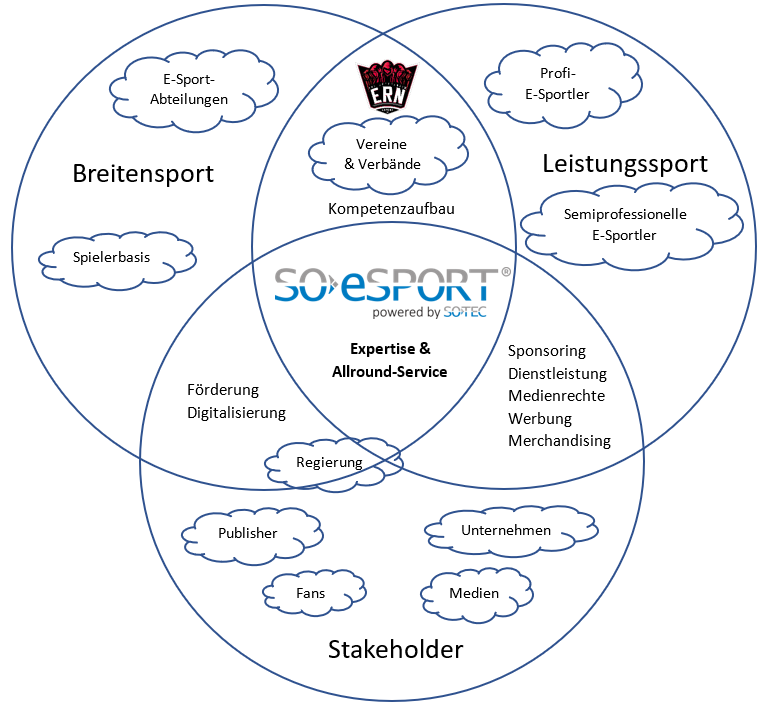
As you can see from the graphic, we are at the central point of the topic of e-sports and its stakeholders. We connect the areas of grassroots and competitive sports by primarily focusing on grassroots sports clubs and advising them, in cooperation with eSport Rhein-Neckar (ERN), on setting up an e-sports department and subsequently providing holistic support and equipping them. SO-eSPORT® also offers more than just high-quality e-sports equipment for competitive sports and at association level! With our expertise and know-how, we enable the infrastructural connection of all involved stakeholders and thus act as a link and contact for e-sports hardware and services at all levels. If, in the future, there is hopefully also supportive wind from politics, almost all participants in the ecosystem would benefit. Because e-sports is much more than just a hype – it is a sport whose right to exist can no longer be debated or denied!
DIGITAL FUTUREmag: Thank you very much for this exciting interview. Digitalization has also made powerful progress here, and you and your company are making a major contribution to this.
*Ed.'s note: Faster, higher, stronger!
Contact:
SOTEC GmbH
Robert-Bosch-Straße 9
69514 Laudenbach
Tel: +49 6201 4974 0
E-Mail: info@sotec.net